The Biggest Influencer Marketing Mistake Has Nothing to Do with Creators
Influencer marketing isn't a creator strategy—it's a funnel strategy. The highest-performing campaigns understand that every creator has a different job to do at each stage of the funnel.
2 min read

It's building campaigns without a clear purpose at each stage of the funnel.
Because influencer marketing isn't a creator strategy. It's a funnel strategy.
I've analyzed 1,500+ influencer campaigns, and the highest-performing ones all had one thing in common:
They understood that every creator has a different job to do.
Here's where most brands get it wrong:
You activate 10 macro-influencers and expect sales. Or you hire 100 nano-influencers and expect reach.
Neither works because you're using the wrong profiles at the wrong stage.
Influencer marketing is a funnel. And each stage needs a different mix.
Here's the framework:
Think of it like team sports. You don't put all strikers on the field. You need defenders, midfielders, and forwards working together.
Here's how it maps:
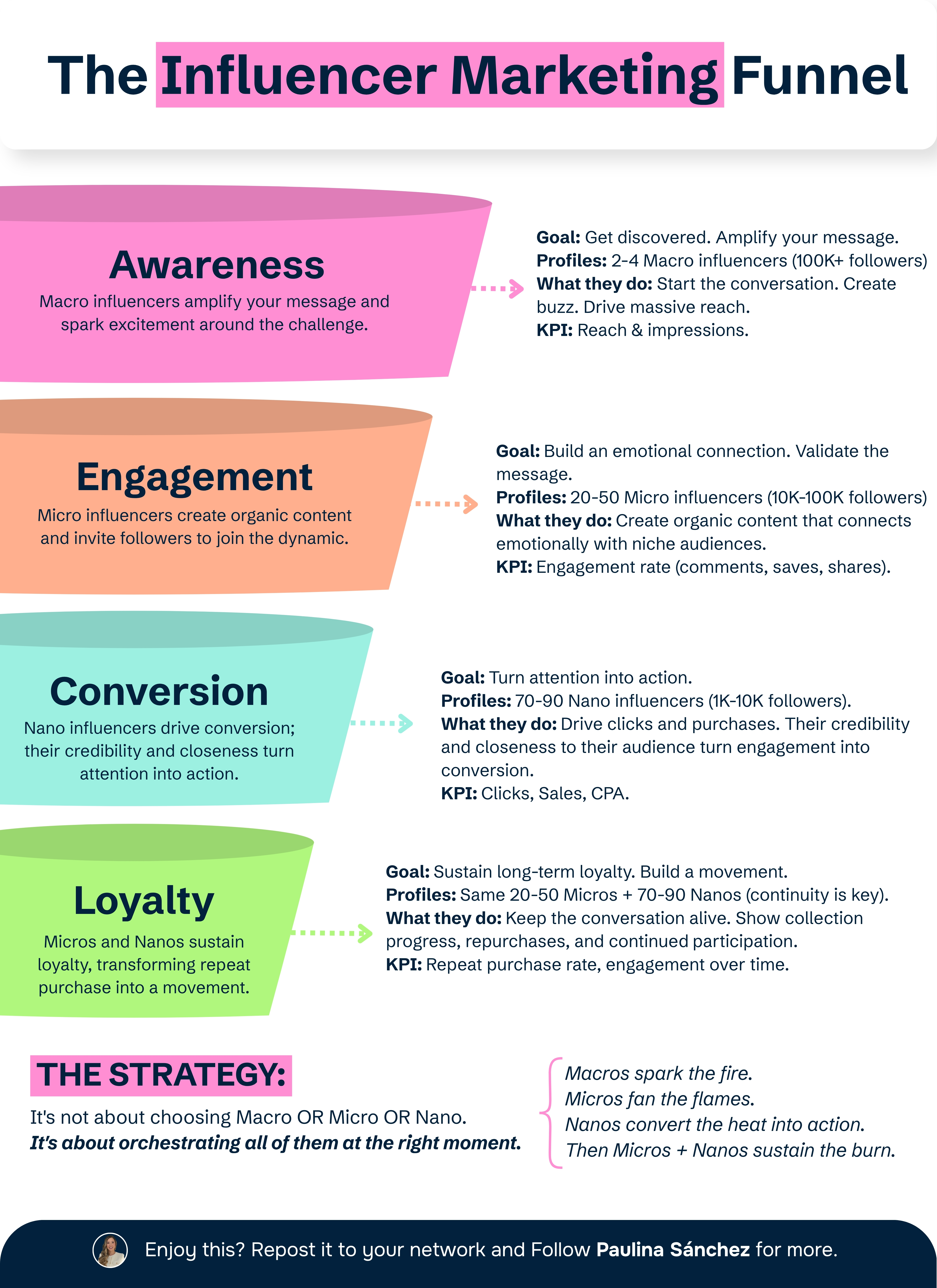
Stage 1: Awareness
Goal: Get discovered and amplify your message. Profiles: 2-4 Macro influencers (100K+ followers). What they do: Start the conversation. Create buzz. Drive massive reach. KPI: Reach & impressions.
Stage 2: Engagement
Goal: Build an emotional connection and validate the message. Profiles: 20-50 Micro influencers (10K-100K followers). What they do: Create organic content that connects emotionally with niche audiences. KPI: Engagement rate (comments, saves, shares).
Stage 3: Conversion
Goal: Turn attention into action. Profiles: 70-90 Nano influencers (1K-10K followers). What they do: Drive clicks and purchases. Their credibility and closeness to their audience turn engagement into conversion. KPI: Clicks, Sales, CPA.
Stage 4: Loyalty
Goal: Sustain long-term loyalty and build a movement. Profiles: Same 20-50 Micros + 70-90 Nanos (continuity is key). What they do: Keep the conversation alive. Show collection progress, repurchases, and continued participation. KPI: Repeat purchase rate, engagement over time.
The strategy:
It's not about choosing Macro OR Micro OR Nano. It's about orchestrating all of them at the right moment.
Macros spark the fire. Micros fan the flames. Nanos convert the heat into action. Then Micros + Nanos sustain the burn.
How to apply this in your next campaign:
→ Map your objective to the funnel stage (Awareness? Conversion? Both?)
→ Match influencer size to the goal (Don't use nanos for reach. Don't use macros for conversion.)
→ Layer them strategically (Start with macros, activate micros + nanos together, sustain with continuity)
→ Measure what matters at each stage (Reach ≠ Sales. Engagement ≠ Clicks.)
Stop losing results by using the wrong creators for the wrong stage.
Build campaigns where every creator has a clear role.
Want to see how this framework looks applied to your next campaign?
Enjoy this?
Follow me on LinkedIn