The 17 points that cannot be missing from your Influencer Marketing brief
After leading campaigns for over 100 B2C brands in 14 countries, I discovered that many campaigns fail due to a poorly constructed brief. These are the 17 essential elements that every brand must include.
2 min read

Many Influencer Marketing campaigns fail before the first creator publishes.
And most of the time, the problem is in a single stage: The brief.
After leading campaigns for over 100 B2C brands in 14 countries, I discovered that many campaigns start with a problem: a poorly constructed brief.
And in an effort to protect what they built, they end up filling the brief with instructions until it becomes a script.
But a good brief is not just about defining what a creator has to publish.
It's about communicating all the context that the influencer needs to create content that meets the campaign objective, without putting the brand at risk.
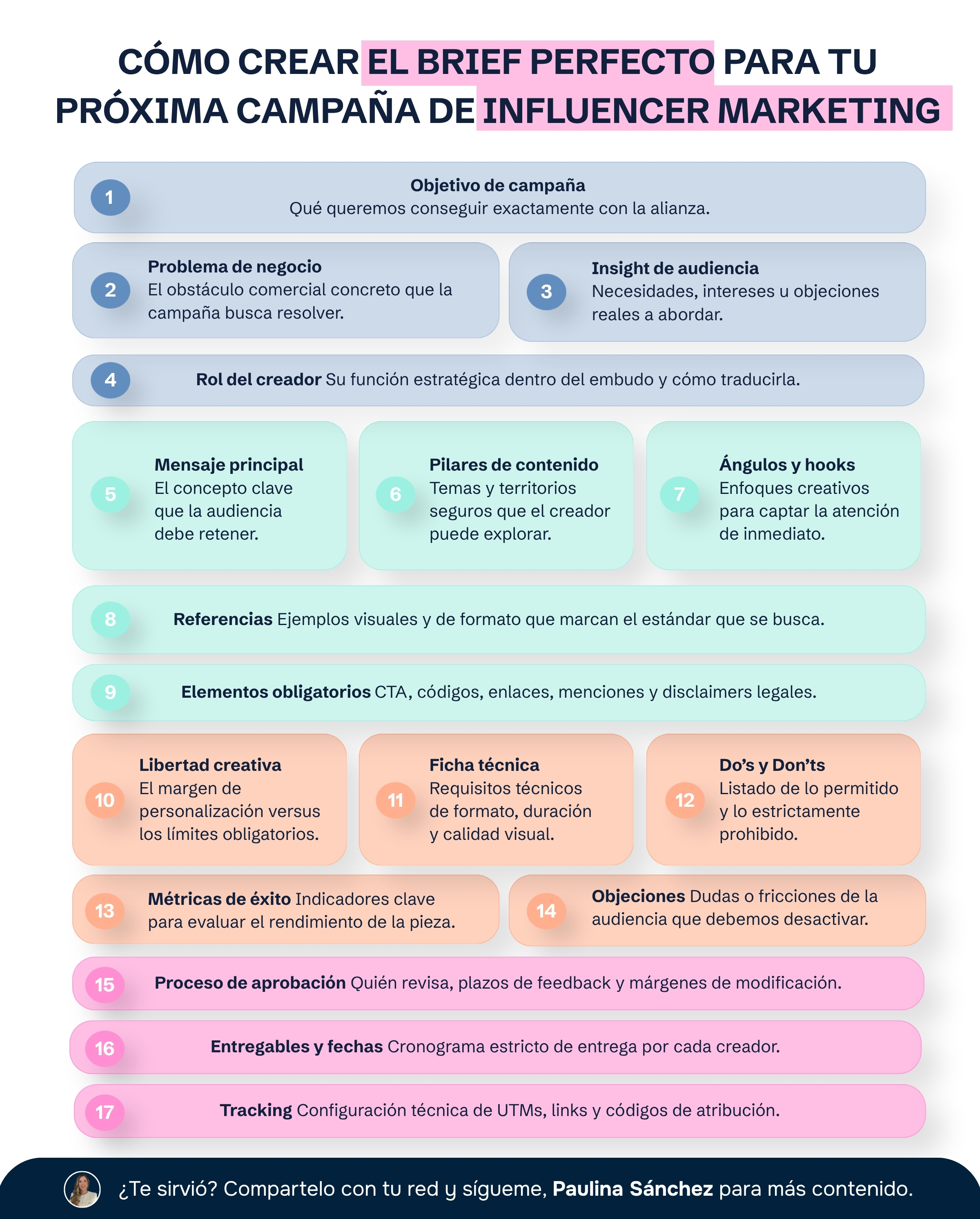
These are the 17 points that cannot be missing from your next Influencer Marketing brief. Most brands use fewer than 5.
1. Campaign objective
→ What we want to achieve with the campaign.
2. Business problem
→ What specific problem we want to solve.
3. Audience insight
→ What needs, interests, or objections of the audience should the content address.
4. Creator's role
→ What role they play within the strategy and how they should translate it into content.
5. Main message
→ What we want the audience to remember after seeing the content.
6. Content pillars
→ What topics or territories the creator can explore.
7. Angles and hooks
→ What approaches they can explore to present the message and capture attention.
8. References
→ What examples help understand what type of content we're looking for.
9. Mandatory elements
→ What must be included: CTA, code, link, disclaimer, mentions, etc.
10. Creative freedom
→ What the creator can make their own and what they must respect.
11. Production guidelines
→ What requirements the piece must meet: format, duration, quality, resources, etc.
12. Do's & Don'ts
→ What they can do and say and what they should avoid.
13. Success metrics
→ What we will measure to determine if the campaign worked.
14. Objections
→ What doubts, questions, or reasons could stop the audience from deciding.
15. Approval process
→ Who reviews and approves the content, what can be modified, and when.
16. Deliverables and dates
→ What each creator must deliver and when.
17. Tracking
→ How the content is tracked and how results are attributed: UTMs, codes, links, hashtags, etc.
The brief is the bridge between strategy and creativity.
When strategy is missing, the creator improvises.
When control is excessive, they stop creating.
The job of the brief is to find that middle ground.
That allows the brand to feel secure, the creator to maintain their authenticity, and the campaign to achieve its objectives.
If you liked this content
Follow me on LinkedIn